Index
- Introduction
- Kerckhoff’s Principle
- Cryptorgraphic keys - Randomness in security
- Symmetric Cryptography
- Block ciphers
- Advanced Encryption Standard
- Modes of operation
- Message Authentication Code (MAC)
- Hash functions
- Authenticated encryption
Introduction
Goals of Cryptrography
Composabilty
Confidentiality and integrity are independent goals.
In fact encryption alone does not detect modifications while integrity protection alone does not hide the content
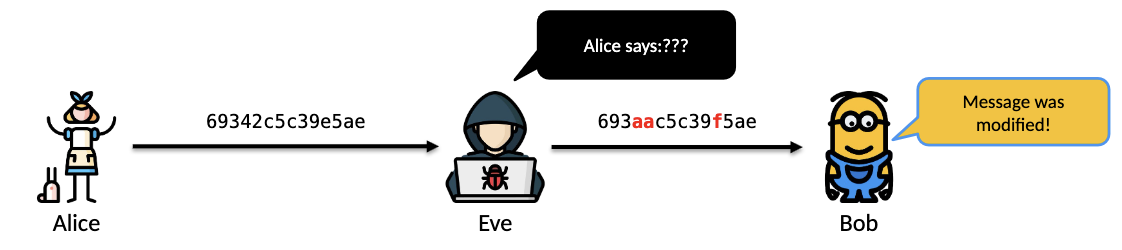
Confidentiality
Only authorized parties can learn information
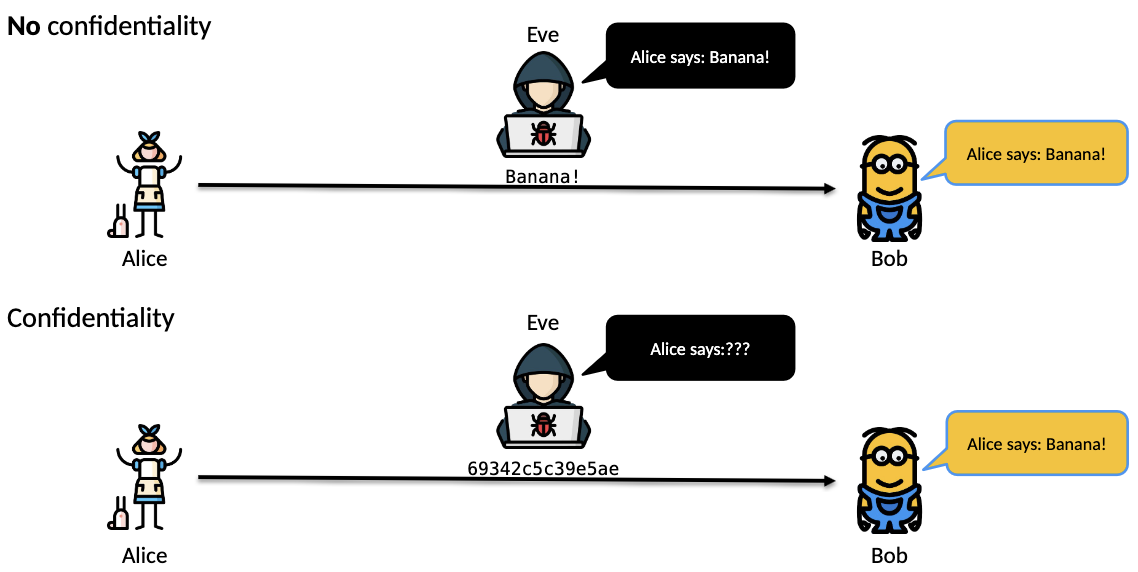
Integrity
The practice of protecting information and systems from improper, unauthorized, or accidental modification, deletion or destruction, by making the receiver aware if the message was compromised or not.
Kerckhoff’s Principle
Cite
”A cryptosystem should be secure if everything about the system, except the key, is public knowledge”
This principle is nowadays considered the standard, thanks to widely analyzed secure cryptosystems.
In fact security through algorithm obscurity is a bad idea because:
- it’s easier to hide a key than an algorithm
- it’s easier to change a key for a single than an algorithm for everybody (containment of beaches)
- it’s easier to communicate if everyone uses the same algorithms
Cryptorgraphic keys
If a key is a bit string of length , the number of possible keys is . So enumerating all of them takes time exponential in .
According to the Kerckoff’s principles there should be no more efficient way to break a cryptosystem then trying all possible keys
Randomness in security
Security very often reduces to how many bits an attacker must guess in order to compromise a cryptosystem, and if the attacker can predict the value, the mechanism is broken, no matter how strong is the algorithm.
This “guessing budget” is the entropy available to the defender (e.g. uniformly random bits → the attacker needs up to guesses)
Entropy definition (background)
Informally, entropy measures the attacker’s uncertainty about a value.
For security, the useful notion is min-entropy (): the attacker’s best single guess
(among all the possible keys select the one with the highest probability of being the right one, while is the number bits necessary to write that number)
So if the most likely value has probability , that values it bits. A uniform -bit value has bits of min-entropy while a skewed distribution has less.
Example
Let’s suppose that of the users select
123456as a password. In this case the most probable value has , so bits.Why min-entropy and not Shannon entropy?
The attacker attacks the most likely case first. This is exactly why human-chosen passwords are weak: the distribution is far from uniform
True Randomness vs. Pseudorandomness
True randomness come from a physical entropy source (e.g. thermal noise, timing jitter, hardware RNGs etc.) and it is slow, has a limited supply, but it’s genuinely unpredictable.
On the other hand pseudorandomness (PRNG) is a deterministic algorithm that stretches a small seed into a long stream. It is fast and unlimited, but fully determined by the seed; so anyone who learns (or guesses) the seed can reproduce the entire stream.
However a stream can pass statistical tests and still be predictable to an attacker (e.g. rand()/Math.random() are meant only for simulations, not security).
Security needs a Cryprographically Secure PRNG (CSPRNG), so that even seeing many outputs, an attacker cannot predict the next bit or recover the state. For this reason typically in security we use the OS source /dev/urandom, getrandom(), CryptGenRandom and not the language’s default random.
Rule of thumb
If a value protects something, it must come from a CSPRNG, well seeded
Symmetric Cryptography
When we talk about symmetric cryptography the communicating parties share a secret key which is unknown to anyone else, and hard to guess. Moreover it can be used for just one session (session key) or for all future communication (long-term key).
Here’s the most important historical examples:
- Caesar cipher → mono-alphabetic shift
- Vigenère cipher → poly-alphabetic shift (only broken 300 years after its publication thanks to cryptoanalysis)
- Enigma → encryption machine used by Germany in WWII (similar to Vigenère cipher)
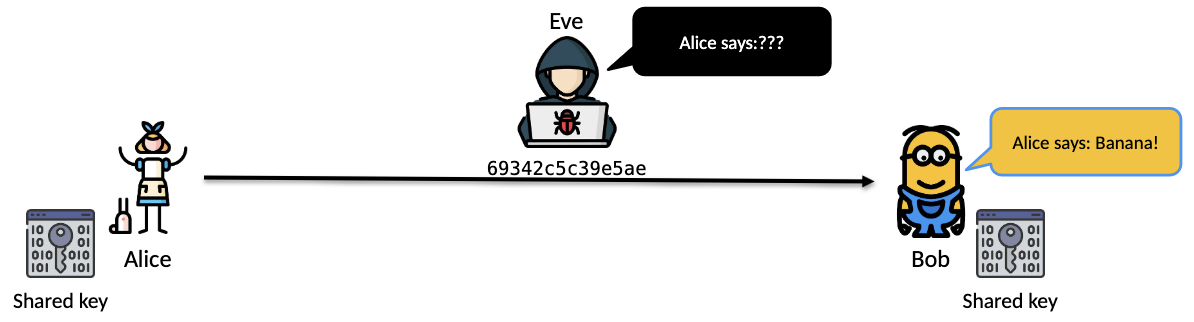
One-Time Pad (OTP)
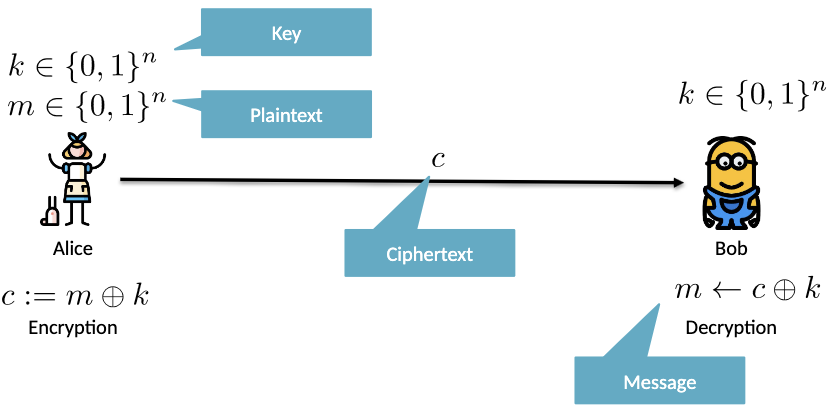
The OTP is perfectly secret, in fact the ciphertext reveals no information about the plaintext (other than its length) and even brute-forcing all keys does not help when the message is sufficiently short (there could be multiple plausible plaintext of the same ciphertext by using different keys).
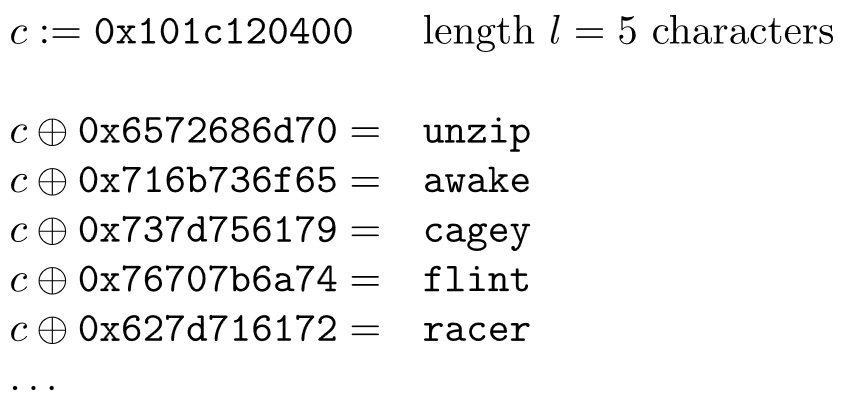
Brute-Forcing the key
Iterating over all 5-byte keys generates all possible 5-byte strings, so it’s impossible to tell which key was the correct one.
In order to make this scheme secure, some conditions must be satisfied:
- a key must be used for exactly one message
- the key must be (at least) as long as the message
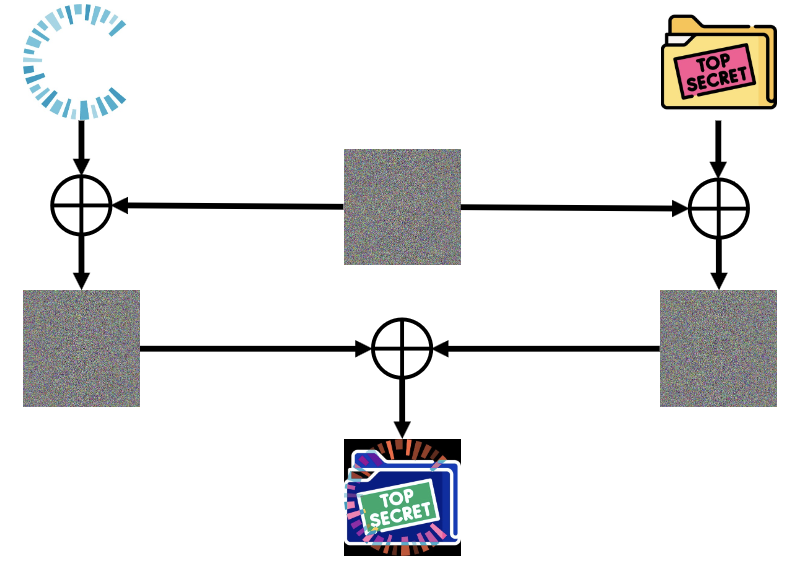
Key reuse leaks information (condition 1 missing)
Encrypting two different messages with the same key you would result in the XOR between the two plaintext messages.
In this way an attacker can obtain lots information about the plaintext; if he knows a part of he can direclty obtain the corresponding part of etc.
Key looking leaks information (condition 2 missing)
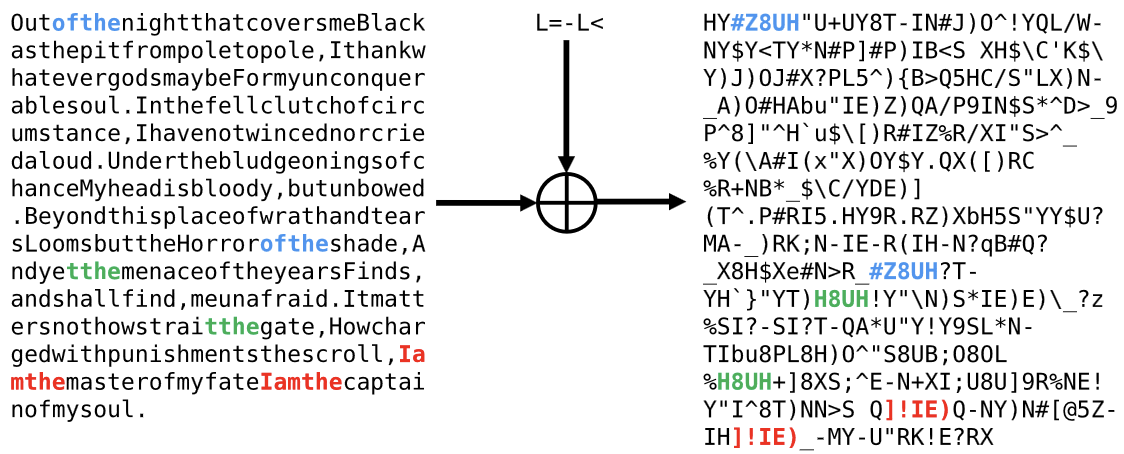
By using a key that is shorter than the message an attacker can obtain information about the plaintext. In fact repeated patterns in the plaintext at a certain distance (the length of the key) would be encrypted in the same way, making this scheme vulnerable to frequency attacks
Breaking a repeated key
If , every byte was XORed with the same key byte . There are three possible attacks:
- split the ciphertext into parts and run frequency analysis on each
- for two blocks of length ; guess parts of wether the resulting is sensible text
- If the plaintext uses only a character class (e.g. lowercase letters), each key byte must map all its ciphertext bytes into that class, which prunes the key space
Block ciphers
Naive encryption via block cipher
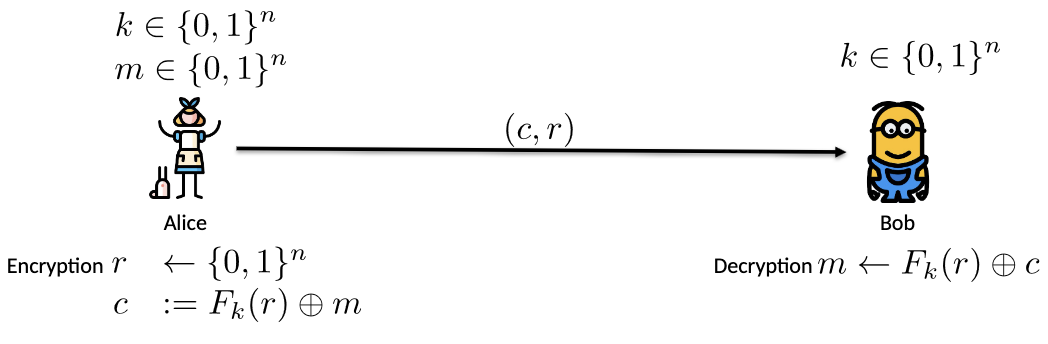
In the naive version of this cipher we have a key as long as message and the idea is to use a fresh random pad , encrypted with , that replaces the OTP key. In this way the key can be used for multiple messages. The drawback is that is twice as long as .
However this naive implementation still remains unpractical to use, we would like to have:
- messages longer than one block
- keys much shorter than messages, and reusable for many messages
- ciphertext not (much) longer than plaintext
- efficient decryption (comparable to encryption)
- patterns in the plaintext must not be visible in the ciphertext
- use to encrypt one block and to decrypt it (not used in naive and CTR)
We can describe as a deterministic pseudorandom permutation (PRP) with key and -bit input such that:
- permutation → a bijection on , so the output is also bits long
- pseudorandomness → for a random key, the output looks random to every efficient algorithm that does not know the key
And a good PRP can be used as a block cipher (like in AES) and good block ciphers fulfill the strict avalanche criterion (flipping one input bit flips every output bit with probability ).
Advanced Encryption Standard
The Advanced Encryption Standard (AES) is the most important block cipher in practice (standardized in 2001), and is commonly used to encrypt whole disks. It uses:
- block size → bits
- key size → ( rounds), ( rounds), ( rounds)
It combines permutation (diffusion) with substitution (confusion); by not using complex mathematical operations (e.g. multiplication, square root, etc.) but just logic operation it can remain computationally lightweight while still needing the same effort for encryption and decryption.
How AES works
1. Inputs. A 128-bit key and a 128-bit data block (the plaintext).
2. Key expansion (E). The key is expanded into 11 different round keys of 128 bits each ( bits), called . They are all derived from the original key and are not the same key repeated.
3. Initial AddRoundKey. XOR the data block with .
4. Rounds 1 to 10. Each round applies four operations to the 4×4 byte state:
- SubBytes → each of the 16 bytes is replaced via a fixed lookup table (the S-box). This is confusion, and it is the non-linear step.
- ShiftRows: the rows of the state are rotated by different offsets, so bytes change position.
- MixColumns → each 4-byte column is mixed so that every output byte depends on all 4 input bytes. Together with ShiftRows, this is diffusion.
- AddRoundKey → XOR the state with the round key of the current round.
(In real AES, the last round skips MixColumns. The image show a generic round.)5. Output. After round 10, the state is the 128-bit ciphertext.
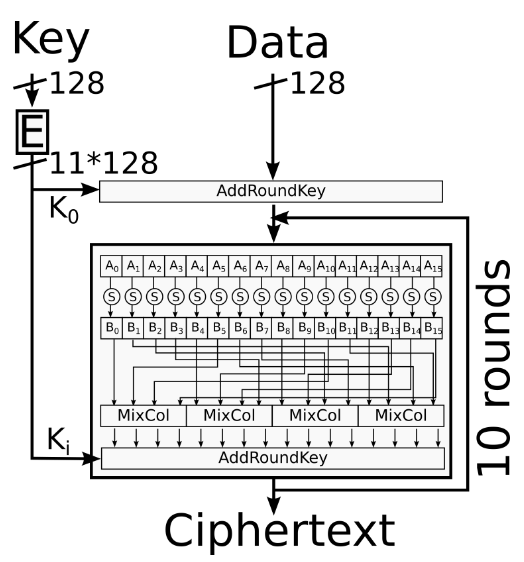
In order to decrypt the ciphertext, each operation is inverted and applied in reverse order. Round keys are derived as for encryption, but applied in reverse order:
- AddRoundKey (XOR) is its own reverse
- MixColumns and ShiftRows can be inverted
- S-box can be inverted
Modes of operation
Block ciphers work of fixed-size blocks (e.g. bits) and its mode of operation describe how to encrypt messages of arbitrary length (e.g. ECB, CBC, CTR, GCM, etc.). All the different modes does not differ on (the same as AES) but changes how it is used.
Warning
Some modes leak plaintext information even if the block cipher is secure.
Electronic Code Book (ECB)
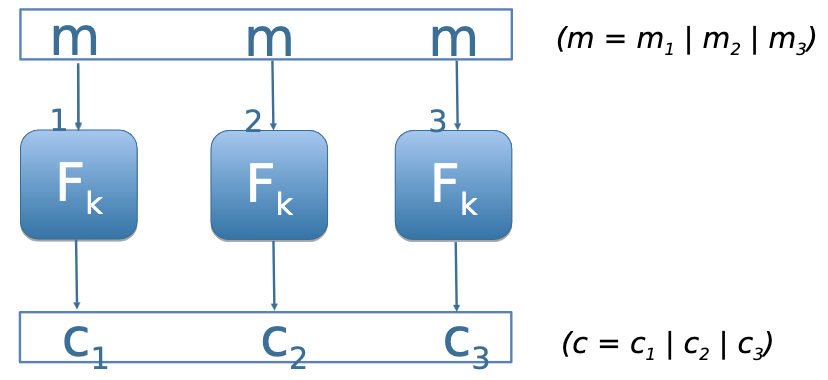
The Electronic Code Book (ECB) encrypts each block separately but reuses the same key for each block permutation, so the encryption of is independent from any other .
Drawbacks
The first drawback is that equal plaintext blocks result in equal ciphertext blocks, so similar plaintext have similar ciphertext (information about the plaintext leaks).
Another drawback is the fact that an attacker could interact and modify the single blocks independently, inserting targeted modifications for specific blocks leaving all the other blocks untouched.
Last bun not least there is the fact that blocks can be exchanged or deleted without affecting other blocks.
Cipher Block Chaining (CBC)
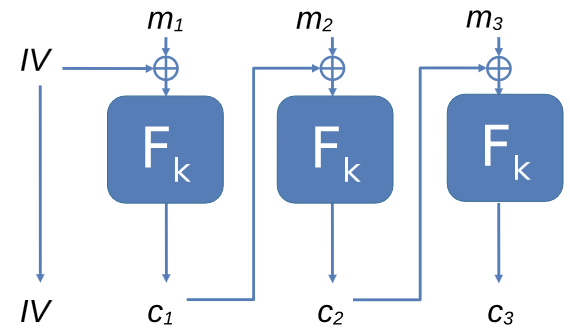
In Cipher Block Chaining (CBC) each plaintext block is XORed with the previous ciphertext block before encryption, while the initialization vector (IV) is a radom, non-secret pad for the first block.
Properties
Advantages over ECB:
- identical plaintext blocks do not result in identical ciphertext blocks (not even the first one, due to the random IV)
- similar plaintext result in different ciphertext
- if an attacker flips a bit in the flip is propagates to
- if an attacker flips a bit in garbles and flips the same bit in
However all that glitters is not gold, in fact the encryption process cannot be parallelized due to the strong data dependencies; contrary it is possible to parallelize the decryption process as the computation of does not depend from any other plaintext block.
CBC does not provide integrity
Despite the error propagation, CBC cannot provide data integrity because the attacker can modify the plaintext in a predictable way and the receiver has no way to determine whether the message is the original one or not.
An attacker who intercepted can:
- flip bits in the IV (1), which flips the same bits in (2)
- flip bits in (3), which flips the same bits in (4) and garbles (5)
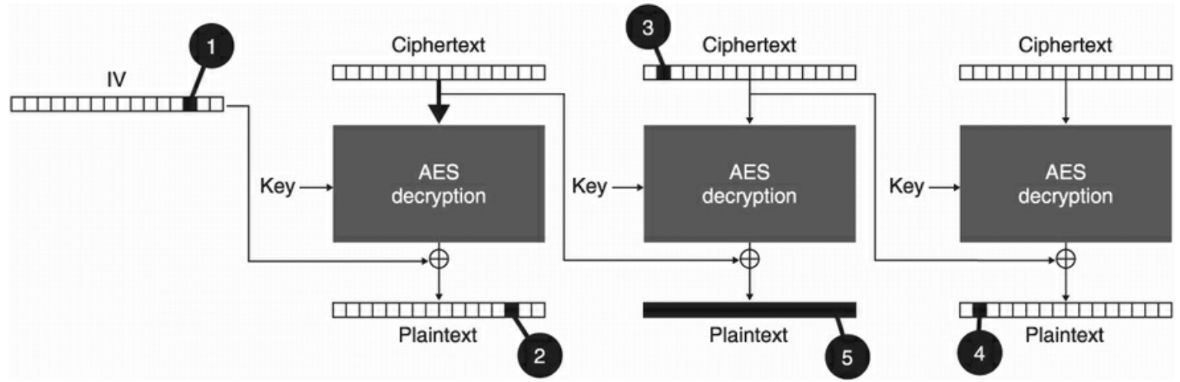
Counter (CTR)
The Counter (CTR) mode turns a block cipher into a stream cipher, by encrypting a nonce (one for each message, not one per block) to produce a keystream and XORs it with the plaintext.
Because it uses one single nonce for each message it’s necessary to concatenate the message with the index of the current block otherwise would be identical for each block (and it would result exactly in the OTP).
Properties
- encryption and decryption can be parallelized, and allow random access
- only is needed, never
- it is the basis of GCM
Warning
Reusing a nonce under the same key would result in the same keystream (the same problem as reusing a one-time pad).
Message Authentication Code (MAC)
A MAC provides data-origin authentication (and hence integrity), using a secret key. In particular the message goes through the function and generates an authentication tag ; the tag is attached to the message, and the receiver can apply the same function to the message and compare the newly generated with the received . If the receiver can be sure that message was not altered by anyone (the only for an attacker to compromise the integrity would be to edit the message and the tag, but in order to generate a valid tag he should have the correct key).

In contrast with a plain checksum (e.g. CRC or bare hash) MAC is able to detect an adversary while checksums just accidental corruption (noise). A MAC detects adversarial modification, and identifies the origin.
Integrity vs. Authentication
- Integrity → has data been altered? (a property of the message)
- Authentication → who produced it? (a property of the origin)
Furthermore we need to distinguish between:
- entity authentication → who am I talking to?
- data-origin authentication → who produced this message? (the one provided by MAC)
Mechanism Integrity? Origin? Hash/CRC (no key) vs. accidental change no MAC/signature (keyed) vs. an adversary yes Password login (entity) not per message who, at session start Authentication implies integrity, but integrity alone does not prove who sent the data. If I know that a message was produced by Alice, I also know that it isn’t been altered (because an altered message does not come from Alice); while an unaltered message may come from anyone.
Naive MAC from a block cipher
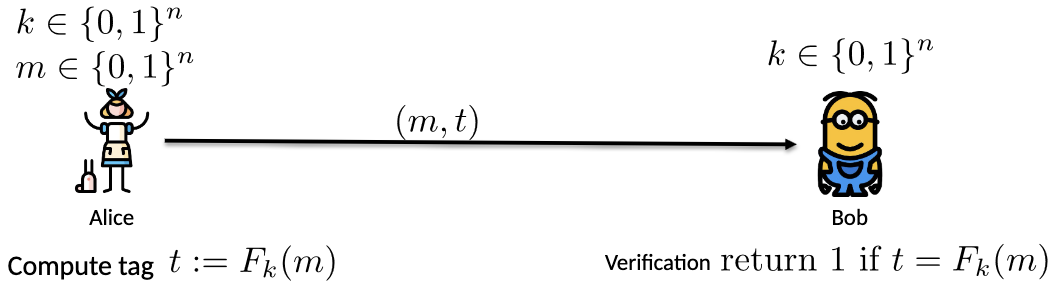
In this case an adversary who does not know cannot forge a valid tag (Bob’s verification succeeds only if Alice generated the message). However it’s not practical because the message must fit into one block.
Hash functions
A cryptographic hash function is deterministic, takes input of any length and is:
- compressing → fixed-length output for arbitrary-length input
- collision resistant → it is practically impossible to find with
- preimage resistant (one-way) → given for a random , it is infeasible to find except by trying all candidates
- second-preimage resistant → given , it is infeasible to find with
The birthday paradox
Making an hash function collision resistant is the harder challenge due to the birthday paradox.
With 23 people in a room, the chance that two share a birthday is because the number of pairs grows quadratically.
For this reason in hash functions a -bit hash, a generic attack needs about messages to find a collision so the output must not be too short. A practical example is the SHA-1 (160 bits) where the best attacks need about operations instead of the generic .
The current standard for hash function is SHA-2 (e.g. SHA-256) and SHA-3 (Keccak).
Security of hash functions over time
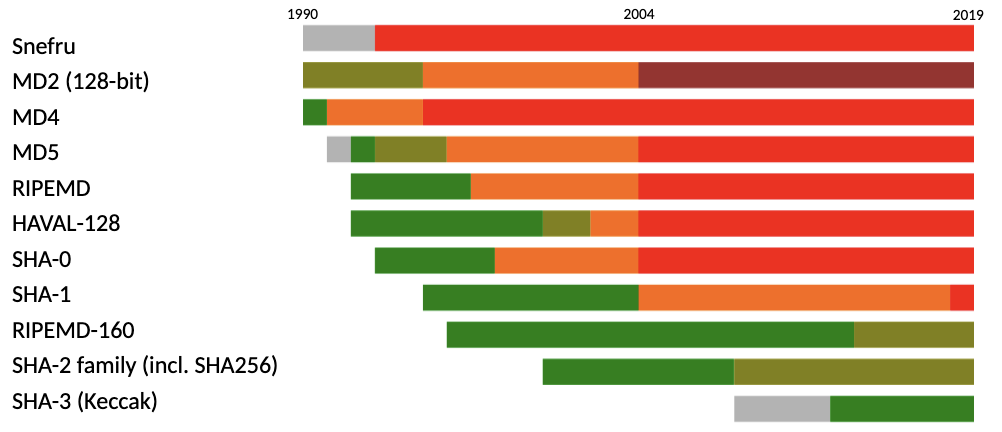
To sum it up:
| Property | Attacker’s task | Generic cost |
|---|---|---|
| Collision resistance | Find any with | |
| Preimage resistance | Given , find | |
| Second-preimage resistance | Given , find with |
Hash vs. MAC
The hash have no key, so everyone can compute it (even the attacker). So if an attacker intercepts a message, modify it and recomputes the hash, the receiver will never know that message has been modified.
The only use of the has is to address an accidental corruption, not an adversary
Hash-and-MAC
The naive MAC only works if the message fits into a block. In order to overcome this limit, first of all we compress the message using an hash function (creating a fixed length hash) and then the is computed on the hash. In this way it’s possible to manage messages of any length.
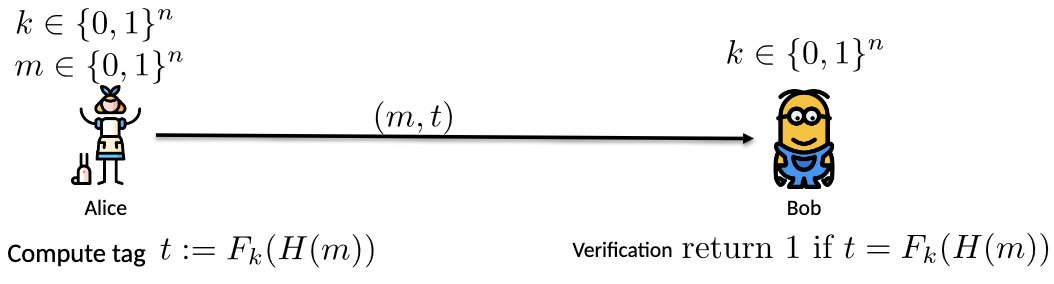
The wrong way
Someone could ask “why don’t we directly hash key and data together, ?”, but with Merkle-Damgard hashes (SHA-1, SHA-256) it’s vulnerable to length extension attacks.
The final digest coincide with the internal state after the last block. An attacker that knows and the length of can then resume the computation from the exact state where the original computation stopped and add some data.
In particular this attack proceeds as it follows:
- Compute the padding → the padding appended to depends only on the length, which the attacker knows. Call it .
- Build the forged message → , where is the data the attacker wants to append. The receiver will compute . The first part, , is exactly what produced , so the state after those blocks is .
- Resume the computation → initialize the hash with state (instead of the IV), process , and add the final padding based on the total length. The result is:
This is exactly the tag the server computes for (which is the message that the attacker is going to send to the receiver. was never needed.
SHA-3 uses a “sponge” construction instead, which prevents extension attacks.
The correct way, HMAC
HMAC is proven secure (in contrast to simple keyed hashes). The encryption consists in two separate hash computations with an inner and an outer key.
where is the key padded with zeros to the hash’s block size (e.g. 512 bits for SHA-256).
In this case the external hash hides the internal state, so the length extension attack is not feasible.
Currently it is still considered secure even with some weaknesses in the hash function (e.g. HASH-SHA1 is still considered secure).
To sum it up in order to use the naive MAC (there are other types of MAC functions that make you use arbitrarily-long messages) you can either:
- hash the message and then apply the MAC function
- use the HMAC
Authenticated encryption
In order to obtain confidentiality and integrity with symmetric encryption you need to combine encryption and a MAC, but not every combination is secure.
In order to achieve this goal we need two independent keys to encrypt, and for the MAC and we suppose that they do not change during a single communication (i.e. two parties exchange messages without changing the key). When it comes to we address any kind of secure MAC protocol (e.g. HMAC, CMAC etc.).
Let’s now analyze all the possible combinations:
- encrypt-and-MAC → and send them together, the MAC is not designed for secrecy and may leak information about (e.g. in repeated messages the MAC is the same - we use the same key - while the encryption is different because the nonce/IV change every time).
- MAC-then-encrypt → , prone to padding-oracle attacks (successfully used against TLS). In fact the receiver could be deciphering data chosen by the attacker; with CBC the deciphering checks the padding, and if the receiver replies in a different way when the padding is wrong, the attacker may be able to reconstruct the plaintext by sending many modified ciphertext and observing the reactions of the receiver.
- encrypt-then-MAC → , sound with independent keys . In this way the receiver verifies the tag before deciphering, and if it doesn’t match trashes everything before touching the ciphertext.
The general rule is that different instances of cryptographic primitives should use independent keys.
Authenticated encryption with associated data (AEAD)
There are modes that provide confidentiality and integrity in one operation. One prime example is GCM (Galois/Counter Mode): the same as CTR, but computes an authentication tag when ciphering. When deciphering the tag is verified and if it doesn’t match, the result is rejected. In GCM every bit flip is detected, so it’s not possible the attack seen for CTR, and its possible to parallelize both encryption and decryption (just like in CTR).
For associated data we refer to authenticated but not encrypted data (e.g. packet headers).
AES-GCM and ChaCha20-Poly1305 are the standard choices today (e.g., in TLS 1.3), but like CTR it’s not possible to reuse a nonce under the same key.